| On
Day Three, we explored the beautiful city
of Florence (Firenze in Italian). This great city is a city
of culture: Culture of the past with its infinite examples
of Renaissance splendor; culture of the present showcased
in exhibitions of contemporary painting, sculpture, cinema,
and fashion.
Ever
since the 19th century revival of interest in the art of the
Renaissance, Florence has been a shrine to the cult of the
beautiful. It lays in Tuscany a stunning province of hills
and mountains, and has produced such famous sons as Leonardo,
Dante, Machiavelli, and Michelangelo.
Florence
is packed with sights. From the Middle Ages onward the Florentines
have been very busy constructing palazzi, churches, and convents.
For more than 400 years it has been one of the leading cultural
cities in Italy. |
We
started our tour of Florence at the Academy of Fine Arts.
The Academy is situated between Piazza San Marco and Piazzo
del Duomo. Pietro Leopoldo, one of the most illuminated of
the Lorraine Grand Dukes, commissioned this museum in 1784
by decreeing that all the schools of drawing in Florence were
to be united into a single Academy and that it was to contain
a gallery of paintings by old masters to help the studies
of the young artists.
Today,
the Academy Gallery is home to the famous statue of David
by Michelangelo. The towering sculpture, acclaimed for its
depiction of male beauty, established Michelangelo as the
foremost sculptor of his time at the age of 29. David was
displayed on Sept. 8, 1504, beside the main doorway of the
Piazza della Signoria to represent a heroic and athletic figure,
the symbol of the freedom of the Florentine Republic. David
remained there until 1873 when was moved to its present location
in the Galleria dell'Accademia (Academy Gallery) to protect
this priceless piece of art. A copy of David stands today
where the original once stood outside the Piazza della Signoria.
Inside
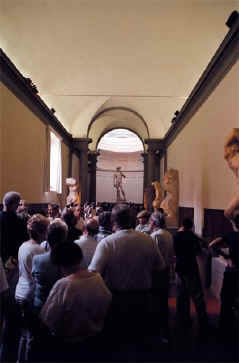
the Academy Gallery, David is displayed in a beautifully lit
Tribune - designed specifically for David by architect De
Fabris. When you first walk into the hall, you see the Captives
(Michelangelo's unfinished sculptures originally for the tomb
of Julius II - these sculptures look like men trying to break
out of the marble that encrusts them). The Captives act as
a guard of honor to David. David is situated at the far end
of this spectacular gallery. It is quite a site, but unfortunately,
we were not allowed to photograph inside the Gallery. I took
the liberty of copying a picture of this hall from the Internet
so you can get a sense of what this gallery looks like.
|