On
Day Four, we headed for Venice. On our way,
we stopped for lunch in Verona. Verona is a very interesting
and beautiful Medieval city. Over the years, Verona became
a very important city due to its geographical location (even
today, it is an important industrial and commercial gateway
to the north and the centre of Italy) and its port provided
access to northern Europe. For this reason, it became one
of the most highly developed urban centers in Italy.
Verona
is one of the richest and most prosperous cities in the North
of Italy. Everywhere you look in Verona, streets are clean,
people wear elegant clothes, and restaurants and shops are
chic (and expensive too!). |
| |
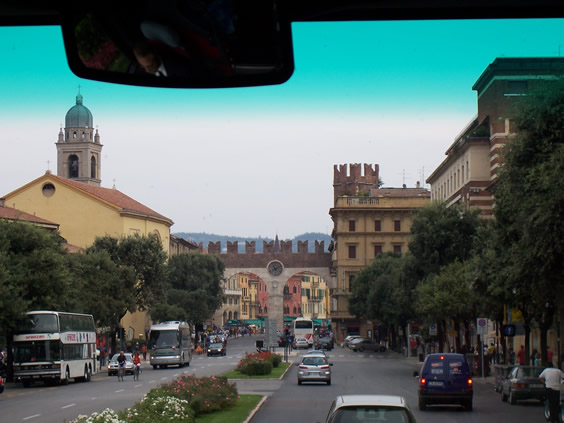
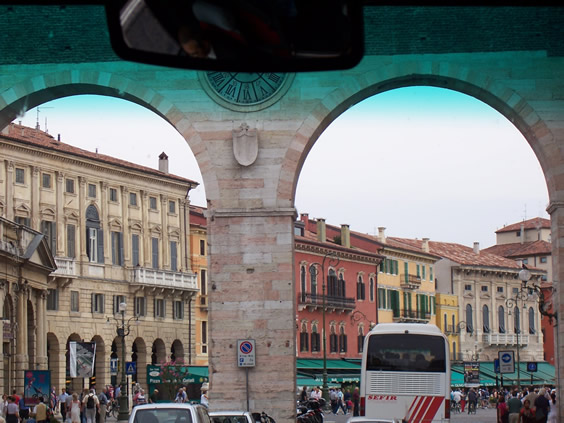
| Portoni
della Bra: |
| The
Portoni della Bra is consisting of two huge arches surmounted
by battlements, which formed part of the walls built by Gian
Galeazzo Visconti at the end of 14th century. The gateway is
flanked on one side by Torre Pentagona, which was also built
at the end of 14th century. This is the main entrance into the
old core of the town, and right behind this gate there is Piazza
Bra and Arena di Verona. |
| |
|
| |
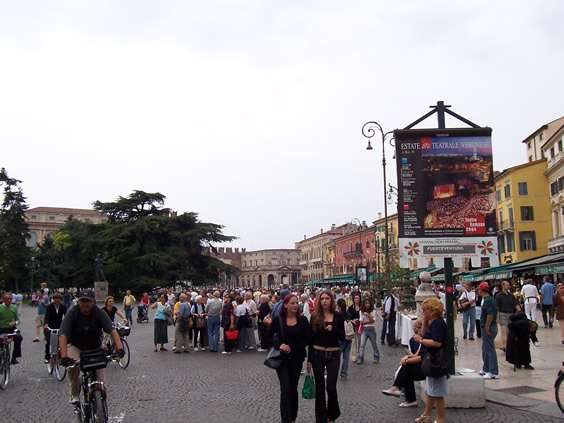
| Piazza
Bra: |
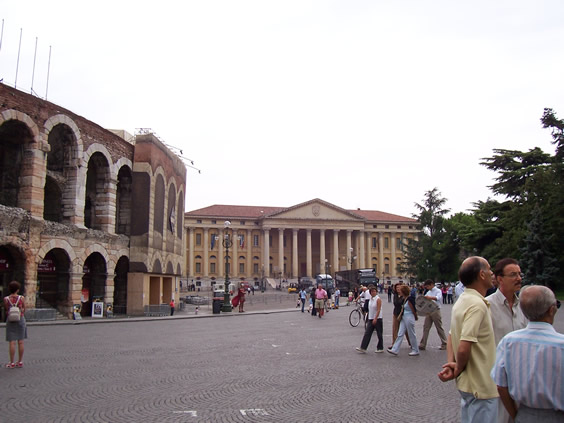
Piazza
Bra is a wide-open space in the historic center of Verona.
This piazza is the heart of Verona. Here you will find the
world-famous arena, as well as ancient palaces (the most famous
are the 16th century Palazzo Malfatti, the 15th century Palazzo
Brognoligo, Palazzo Gianfilippi, Palazzo Barbieri, and the
town hall).
Every
tourist winds up in Piazza Bra’. Trains terminate here
and cars tend to park around here. This piazza is dominated
by the Arena, where it is possible to enjoy opera productions
during the summer. |
| |
| Overlooking
Piazza Bra (left) / Part of the City Wall (right): |
|
| |
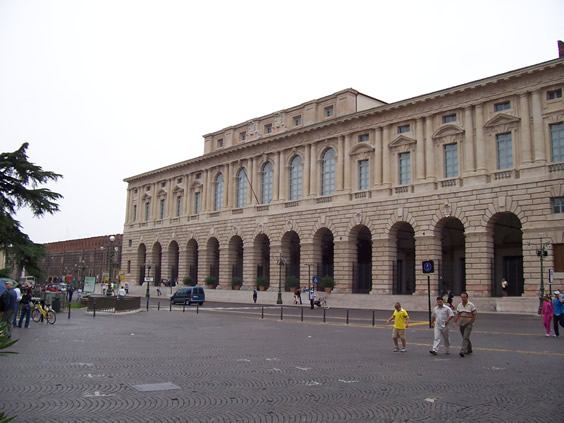
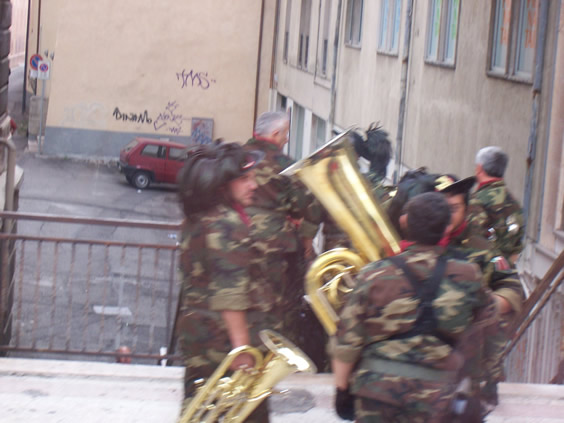
| Palazzo
Barbieri (left) / Verona's Military Marching Band (right): |
The
neo-classical building of the Palazzo Barbieri
is at the southeast end of Piazza Bra, right next to
the Arena. This Palazzo has, since 1874, been the Town
Hall of Verona. It is also referred to as the Gran Guardia
Palace.
I
wasn't able to get a good photograph of the Military
Marching Band, but this was the best I could do
from the bus. Apparently, this marching band doesn't
just march while playing music, they actually run. I
would have liked to seen them in action. |
|
| |
| Arena
di Verona: |
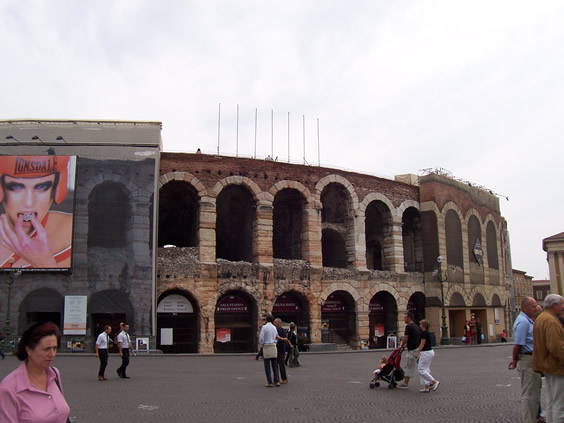
Like
the Colosseum in Rome, the Arena di Verona
is an ancient Roman Amphitheater. It was built in the
first century A.D. and has been expertly preserved,
thus making it one of the world's most evocative and
important operatic theatres. The interior is elliptical
and measures 44.43m X 73.58m.
It
is the third largest building of its type and is the
most well preserved. It has been used to host games
and battles, plays in the 12th century, jousting in
the Middle Ages, and in 1913, it became the largest
operatic theater in the world. The acoustics and the
sheer size of the place lend themselves well to grandiose
operatic performances.
|
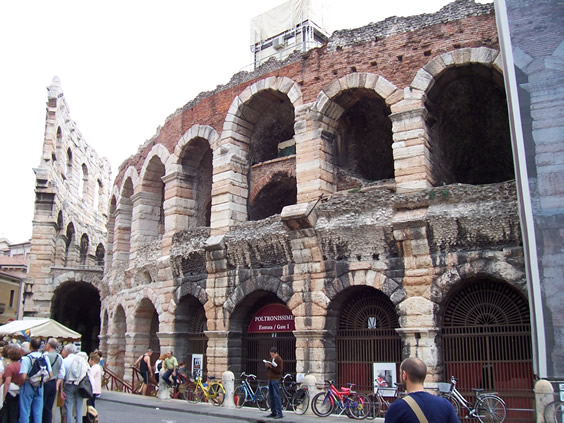
The
only remaining part of the original facade (left) |
 |
|
| |
 Florence | Next
Page
Florence | Next
Page  |
|